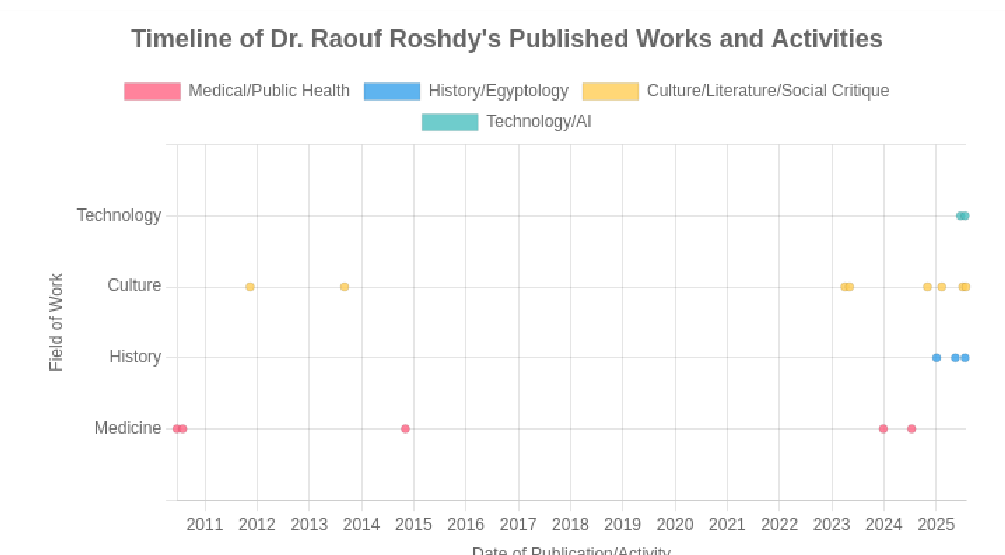

Introduction: The Physician, The Historian, The Critic
Dr. Roshdy extends his medical practice beyond the clinic walls, actively engaging in public health education. He utilizes mainstream media platforms to demystify complex medical topics and provide accessible guidance to a broad audience. His writings demonstrate a clear commitment to preventive care and informed decision-making, addressing crucial life stages and common health concerns. For instance, in a detailed article for the popular news portal *Youm7*, he addresses the importance of pre-marital health screenings. In it, he moves from statistical realities—such as the prevalence of genetic disorders in Egypt—to the practical benefits and legal requirements of such tests, covering everything from hereditary blood diseases to infectious diseases like Hepatitis B. This work is not just informational; it is a form of public service, aiming to prevent future health crises for families. His role as an educator also extends to maternal health, with articles providing practical advice for expectant mothers. He has written on topics such as the benefits and precautions of exercise during pregnancy and a "Pregnant Woman's Guide in the Summer." He also tackles men's health, explaining the complexities of hormones like Testosterone. By publishing in widely read outlets, he ensures his medical expertise reaches beyond the confines of academia and specialized practice, contributing to a more health-literate society
Part 1: The Physician: A Career in Medicine and Innovation
At the core of Dr. Raouf Roshdy's public and professional identity lies his long-standing career in medicine. This is not merely a backdrop for his other intellectual pursuits but the very foundation upon which they are built. His work as a physician is characterized by a dual commitment: to the immediate, practical needs of his patients and to the broader, forward-looking evolution of healthcare itself. He is both a practitioner and a theorist, a clinician and an innovator, whose medical career reflects a deep engagement with the present challenges and future possibilities of his field
Core Professional Identity: A Foundation in Reproductive Health
This article aims to synthesize these identities to paint a comprehensive portrait of Dr. Raouf Roshdy, a modern Egyptian polymath whose work bridges the seemingly distant worlds of science, history, and public discourse. He represents a contemporary iteration of the "Renaissance man," an intellectual figure who refuses the confines of a single specialization. His career demonstrates that a profound understanding of medicine can inform historical inquiry, that a passion for history can enrich a scientific worldview, and that a critical engagement with culture is essential for both. Through his diverse body of work—from peer-reviewed medical journals to popular newspaper columns and deeply personal essays—Dr. Roshdy challenges the silos of modern knowledge. To understand this multifaceted figure, we will navigate his intellectual landscape in three parts. First, we will explore his foundational identity as a medical professional, a consultant in reproductive health whose work is grounded in clinical practice yet consistently looks toward technological innovation. Second, we will delve into the world of his writer's pen, examining his contributions as a cultural critic, a passionate historian of antiquity, and a connoisseur of arts and literature. Finally, we will analyze his scholarly output, where these diverse interests converge, revealing a unified intellectual method that applies scientific rigor to humanistic questions. Through this exploration, a portrait emerges of not just a doctor who writes, but a thinker for whom medicine, history, and culture are inseparable facets of the human experience. Part 1: The Physician: A Career in Medicine and Innovation At the core of Dr. Raouf Roshdy's public and professional identity lies his long-standing career in medicine. This is not merely a backdrop for his other intellectual pursuits but the very foundation upon which they are built. His work as a physician is characterized by a dual commitment: to the immediate, practical needs of his patients and to the broader, forward-looking evolution of healthcare itself. He is both a practitioner and a theorist, a clinician and an innovator, whose medical career reflects a deep engagement with the present challenges and future possibilities of his field. Core Professional Identity: A Foundation in Reproductive Health Dr. Roshdy's primary specialization is as a Consultant in Obstetrics, Gynecology, and Assisted Reproductive Technology (ART). This role places him at the forefront of one of medicine's most sensitive and technologically dynamic fields. His professional affiliations ground his work in established medical institutions, including Bedaya Hospital and a practice in the Mohandessin district of Giza, a prominent area in Greater Cairo. His standing in the medical community is further solidified by his role as a Board Member of the Egypt Health Foundation, a position that suggests involvement in healthcare policy and strategy on a national level. What distinguishes his profile is the breadth of his qualifications. Beyond his core specialty, he holds diplomas in Family Medicine and Medical Informatics. This combination is telling. The Family Medicine diploma points to a holistic, patient-centered approach, while the Medical Informatics diploma signals an early and sustained interest in the intersection of healthcare and information technology. This dual expertise, cultivated long before "digital health" became a buzzword, positions him as a bridge between traditional clinical practice and the data-driven future of medicine.
Public Health Advocate and Educator
Dr. Roshdy’s medical identity is most sharply defined by his engagement with the future. His interest is not just in practicing medicine as it is, but in shaping what it will become. This is most evident in his work on artificial intelligence and other emerging technologies. His book, AI in Modern Health Care: Practice, Search and Medical writing, published in mid-2025, represents a landmark achievement. Described as the "first globally integrated framework for the application of Artificial Intelligence in reproductive healthcare," this work positions him as a thought leader. The book's title itself is revealing: it addresses not only the *practice* of AI in medicine but also its role in *search* and *medical writing*, reflecting his own multifaceted career. His Key Takeaways: The Physician Core Identity: Dr. Roshdy is a highly qualified Consultant in Ob/Gyn and ART, with additional diplomas in Family Medicine and Medical Informatics, indicating a holistic and tech-savvy approach. Public Educator: He actively uses mainstream media to educate the public on vital health issues like pre-marital screening, maternal health, and hormonal science. Innovator and Futurist: His work, particularly his book on AI in healthcare, establishes him as a thought leader focused on integrating technology into medicine, acting as both a creator and a communicator of innovationLinkedIn tagline, innovationLinkedIn tagline,
A Forward-Looking Medical Thinker
Dr. Roshdy’s medical identity is most sharply defined by his engagement with the future. His interest is not just in practicing medicine as it is, but in shaping what it will become. This is most evident in his work on artificial intelligence and other emerging technologies. His book, AI in Modern Health Care: Practice, Search and Medical writing, published in mid-2025, represents a landmark achievement. Described as the "first globally integrated framework for the application of Artificial Intelligence in reproductive healthcare," this work positions him as a thought leader. The book's title itself is revealing: it addresses not only the *practice* of AI in medicine but also its role in *search* and *medical writing*, reflecting his own multifaceted career. His LinkedIn tagline AI is your Copilot Not your Autopilot," encapsulates his philosophy: technology as a powerful tool to augment, not replace, human expertise. Beyond his own book, he acts as a communicator of complex medical advancements to the public. Prominent media figure Hala Sarhan highlighted his writings on a "medical breakthrough" from France: the development of artificial veins that can grow within the body and transform into real blood vessels. Sarhan praised Dr. Roshdy for explaining how "something from imagination became a reality." This role as a trusted interpreter of cutting-edge science is crucial, bridging the gap between the laboratory and public consciousness and demonstrating his ability to translate highly specialized knowledge into compelling, understandable narratives. Key Takeaways: The Physician Core Identity: Dr. Roshdy is a highly qualified Consultant in Ob/Gyn and ART, with additional diplomas in Family Medicine and Medical Informatics, indicating a holistic and tech-savvy approach. Public Educator: He actively uses mainstream media to educate the public on vital health issues like pre-marital screening, maternal health, and hormonal science. Innovator and Futurist: His work, particularly his book on AI in healthcare, establishes him as a thought leader focused on integrating technology into medicine, acting as both a creator and a communicator of innovation.
Part 2: The Writer's Pen: A Voice on Culture, History, and Society
While medicine provides the empirical foundation for Dr. Raouf Roshdy's work, it is through his writing that his full intellectual range is revealed. His pen is a versatile instrument, moving with ease from incisive social critique to meticulous historical investigation and intimate literary reflection. This body of work, published in outlets ranging from cultural magazines to national newspapers, establishes him as a prominent public intellectual who engages deeply with the defining questions of Egyptian identity, past and presen
The Social and Cultural Critic
Dr. Roshdy is a keen and often trenchant observer of contemporary Egyptian society. His critical essays are not detached academic exercises; they are sharp, timely interventions into public discourse, analyzing societal shifts with a diagnostician's eye for underlying causes. His landmark article, "From the Returnees to the 'Nouveau Riche': A Narrative of Extravagance," serves as a powerful example of his method. In it, he traces a direct lineage of cultural change from the 1990s to the present. He begins with the "returnees from the Gulf," a generation that acquired wealth without a corresponding cultural or class framework, leading to a culture of "ostentatious consumption." He then connects this to the rise of the "digital nouveau riche"—social media influencers and "creators of empty content"—who now dominate the cultural landscape. His analysis is unsparingThis overlapping class... began to impose a new musical taste, based on loud rhythm and vulgar words... The 'festival' transformed from an event into a musical genre, and from a musical genre into a whole culture of dress, speech, gestures, and showing offHe diagnoses the danger not in the existence of new wealth, but in the model of success it promotes: a "model of absurdity" where value is measured by the loudest voice, not the deepest thought. The essay concludes with a stark warning that unless society reclaims the value of "taste" (وقﺬﻟا) and "thought" (ﺮﻜﻔﻟا), it risks becoming a "skyscraper built of mud." His intellectual range as a critic is also evident in his more philosophical and satirical pieces. In "A Very Trivial Article" (اًﺪﺟ ﻪﻓﺎﺗ لﺎﻘﻣ), he masterfully uses irony to explore the nature of superficiality. He argues that "triviality is an art form," a "talent" requiring a lifetime of dedication to avoid deep thought and critical self-reflection. By satirically praising the "trivial person," he crafts a powerful critique of anti-intellectualism and celebrates the "torment" of a thinking mind. This, along with his reflections on the future of print media, showcases a writer deeply engaged with the cultural and intellectual currents of his time
The Historian and Egyptologist
analyzing societal shifts with a diagnostician's eye for underlying causes. His landmark article, "From the Returnees to the 'Nouveau Riche': A Narrative of Extravagance," serves as a powerful example of his method. In it, he traces a direct lineage of cultural change from the 1990s to the present. He begins with the "returnees from the Gulf," a generation that acquired wealth without a corresponding cultural or class framework, leading to a culture of "ostentatious consumption." He then connects this to the rise of the "digital nouveau riche"—social media influencers and "creators of empty content"—who now dominate the cultural landscape. His analysis is unsparing: This overlapping class... began to impose a new musical taste, based on loud rhythm and vulgar words... The 'festival' transformed from an event into a musical genre, and from a musical genre into a whole culture of dress, speech, gestures, and showing off. He diagnoses the danger not in the existence of new wealth, but in the model of success it promotes: a "model of absurdity" where value is measured by the loudest voice, not the deepest thought. The essay concludes with a stark warning that unless society reclaims the value of "taste" (وقﺬﻟا) and "thought" (ﺮﻜﻔﻟا), it risks becoming a "skyscraper built of mud." His intellectual range as a critic is also evident in his more philosophical and satirical pieces. In "A Very Trivial Article" (اًﺪﺟ ﻪﻓﺎﺗ لﺎﻘﻣ), he masterfully uses irony to explore the nature of superficiality. He argues that "triviality is an art form," a "talent" requiring a lifetime of dedication to avoid deep thought and critical self-reflection. By satirically praising the "trivial person," he crafts a powerful critique of anti-intellectualism and celebrates the "torment" of a thinking mind. This, along with his reflections on the future of print media, showcases a writer deeply engaged with the cultural and intellectual currents of his time. The Historian and Egyptologist Dr. Roshdy's passion for history, particularly the history of ancient Egypt, is a defining feature of his intellectual life. He approaches the past not as a collection of settled facts but as a living field of inquiry, ripe for re-examination with a modern, scientific lens. His work in this area serves as a powerful bridge between his medical expertise and his humanistic curiosity. His most significant contribution is the research study, "Medicine in Ancient Egypt: A Comprehensive Study," published in the *Aswan Africa Obstetrics & Gynecology Journal*. The choice of a medical journal for a historical study is itself a statement, underscoring the scientific rigor of his approach. The study moves beyond simple narration, analyzing medical papyri like the Ebers and Edwin Smith papyri to reveal a remarkably sophisticated medical system. In media interviews discussing his research, he emphasizes that "medicine is a Pharaonic industry" and that the ancient Egyptians had already moved beyond magical thinking to a system with specialized doctors for internal medicine, dentistry, and mental health (treated by priests)
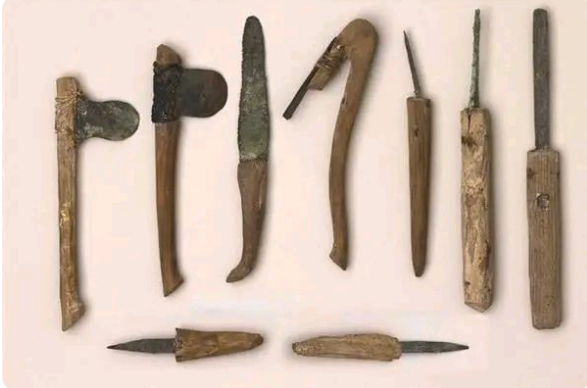
A collection of ancient surgical and medical tools, likely from ancient Egypt, showcasing the types of instruments used in early medical procedures
One of his most compelling revelations concerns the field of compensatory medicine. He argues that the ancient Egyptians were pioneers in prosthetics, not for comfort, but for religious reasons. Their belief in the necessity of a complete body for the afterlife drove them to develop artificial limbs to replace missing ones. This insight connects medical practice directly to the core belief system of the civilization. He also highlights evidence of stunningly advanced surgical procedures. He discusses a mummy named Usermontu, whose X-rays revealed a metal screw in the femur. Microscopic analysis showed tissue interaction around the screw, proving it was inserted during the patient's lifetime as part of a successful surgical operation—arguably the first of its kind in history. This, along with evidence of successful brain surgery (trepanation), points to a deep, practical knowledge of orthopedics, anesthesia, and anatomy that predates similar developments in the modern world by millennia. His historical curiosity is not confined to Egypt. An article on the "Pillars of Baalbek" in Lebanon, where he explores the "impossible journey" of their transportation, shows a broader interest in the marvels of ancient engineering and the enduring mysteries of the past. For Dr. Roshdy, history is a source of endless questions that inspire "debate between pioneers of science and lovers of mystery.
The Connoisseur of Arts and Literature
Dr. Roshdy’s writings also situate him firmly within Egypt's vibrant intellectual and artistic circles, both as a participant and an appreciative observer. He is not an outsider looking in, but someone who has been part of the conversation. A crucial piece of evidence for this is his connection to the circle of Nobel laureate Naguib Mahfouz. In an article about Raymond Stock, Mahfouz's American biographer, Dr. Roshdy places himself directly within the famed "Harfish" intellectual salon. He describes the weekly gathering at a Nile-side casino, listing the attendees: "Ali Salem, Naim Sabri, Farag Foda... Raouf Roshdy, and among them a handsome, silver-haired foreigner... named Raymond Stock." This single sentence is a powerful statement, positioning him in the direct lineage of major 20th-century Egyptian thought and debate, alongside some of the era's most important writers and thinkers. His appreciation for the arts is also expressed in more personal, aesthetic reflections. His essay "Do You Like Brahms?" is a masterful piece of autobiographical writing. It weaves together childhood memories of his father's library, a youthful encounter with the title of a Françoise Sagan novel, and the adult experience of hearing his son (a dental student) play Brahms on the piano. The essay is a meditation on how literature, music, and family memory intertwine to shape an individual's inner life. It reveals a sensibility deeply attuned to the emotional power of art. This appreciation extends to his contemporaries. He wrote a glowing tribute to Dr. Mohamed Abou El- Ghar, celebrating him as an "exceptional figure" who combines medicine, history, art, and sports. In praising a fellow polymath—a pioneer in IVF, an art collector, a historian, and a public intellectual— Dr. Roshdy not only honors a colleague but also implicitly champions the ideal of a multifaceted intellectual life that he himself embodies
Part 3: The Scholar: Bridging Medicine, History, and Technology
If Dr. Roshdy's medical career is his foundation and his writing is his public voice, then his scholarly work is the intellectual crucible where his diverse interests are fused. It is in the realm of formal research and academic publication that the physician, the historian, and the technologist most clearly converge. This body of work demonstrates that his wide-ranging pursuits are not a form of intellectual dilettantism but are instead governed by a consistent, rigorous methodology that seeks to bridge disciplines and generate new knowledge at their intersection.